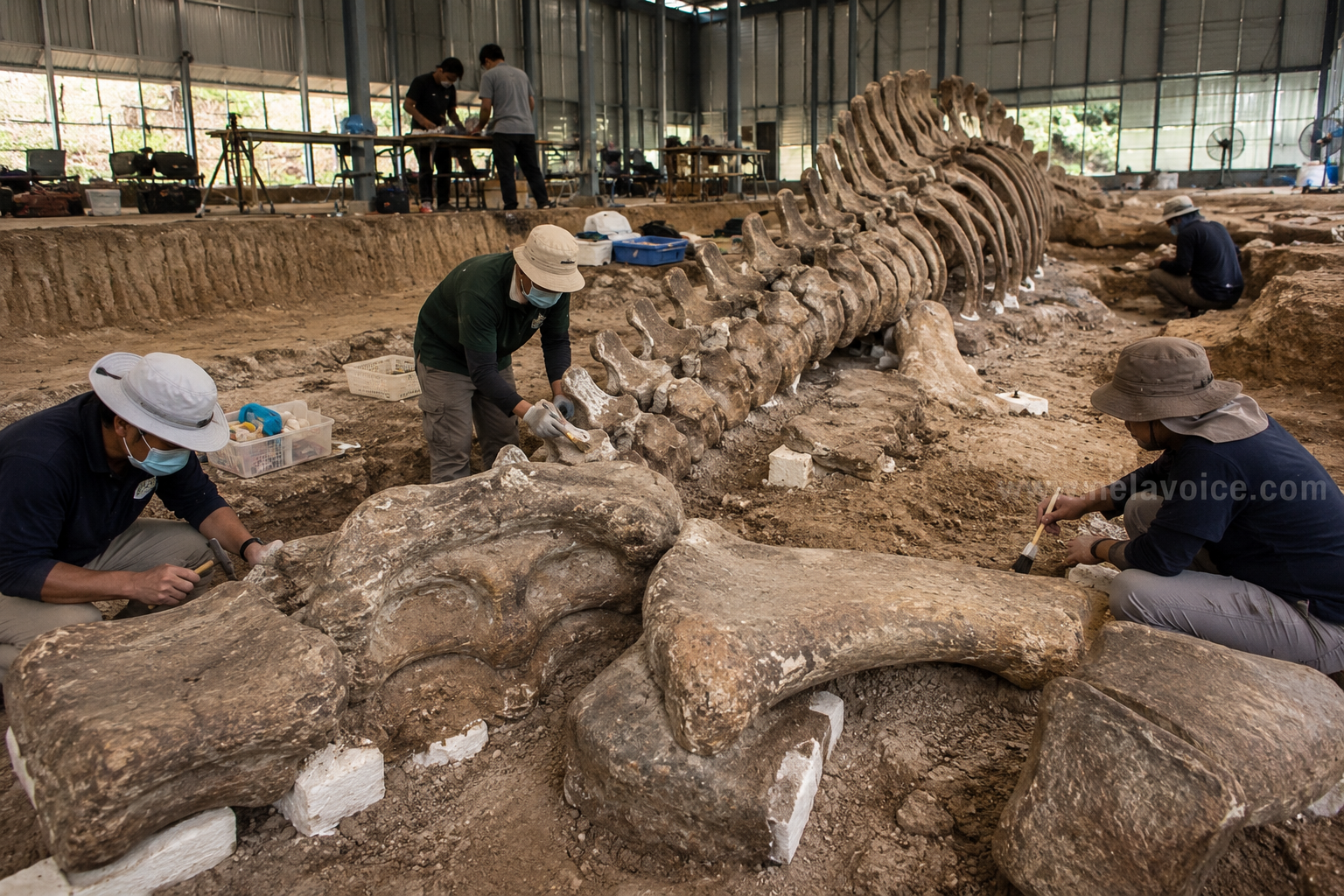
Scientists in Thailand have uncovered fossils belonging to what is now believed to be the largest dinosaur ever discovered in Southeast Asia, a massive long-necked species that lived approximately 113 million years ago during the Early Cretaceous period.
The newly identified dinosaur has been named Nagatitan chaiyaphumensis and belongs to the sauropod family — a group of gigantic plant-eating dinosaurs famous for their enormous bodies, extremely long necks, and powerful tails. Researchers estimate the prehistoric giant measured nearly 90 feet in length and weighed between 25 and 28 tons.
The fossils were first discovered by a local villager in Thailand’s Chaiyaphum province, prompting scientists to begin a detailed excavation and research project that continued over several years. The recovered remains included parts of the spine, ribs, pelvis, and leg bones, including a front limb bone measuring nearly six feet in length.
Paleontologists believe Nagatitan primarily survived on large quantities of vegetation such as conifers and seed ferns that existed in the region millions of years ago. Due to its enormous size and strength, researchers say the dinosaur likely had very few natural predators during its lifetime.
Scientists also explained that the prehistoric environment of what is now Thailand was dramatically different from today. The area is believed to have consisted of warm semi-arid landscapes with forests, rivers, and open savanna-like environments inhabited by crocodiles, fish, flying reptiles, and several other dinosaur species.
The dinosaur’s name was inspired by the “Naga,” the serpent-like mythical figure found in several Asian religious traditions and deeply connected to Thai culture and temple architecture. Researchers say the name reflects both the dinosaur’s immense appearance and the region’s cultural heritage.
Experts believe the discovery is highly significant because it provides valuable insight into dinosaur diversity and evolution within Southeast Asia, a region where fewer giant dinosaur fossils have historically been discovered compared to areas such as North America or China.
The discovery also helps scientists better understand how giant sauropods adapted and evolved during periods of high global temperatures and changing prehistoric climates. Researchers noted that Nagatitan is among the youngest and largest sauropods ever identified in Southeast Asia.
For Sri Lanka and the wider South Asian region, discoveries like this continue to generate growing public interest in paleontology, prehistoric life, and Earth’s ancient environmental history. Educational institutions and science communities across Asia have increasingly focused on promoting interest in natural history and fossil research among younger generations.
Scientists say Southeast Asia may still contain many undiscovered prehistoric species hidden beneath ancient geological formations, and further excavations could reveal additional evidence about how dinosaurs evolved and spread across the region millions of years ago.
Meanwhile, the fossil remains of Nagatitan are expected to become an important scientific and cultural attraction in Thailand, potentially boosting educational tourism and international research collaboration in the future.
What happens next will involve further scientific analysis of the fossils as researchers continue studying the dinosaur’s anatomy, evolutionary history, and relationship to other giant sauropod species discovered around the world.