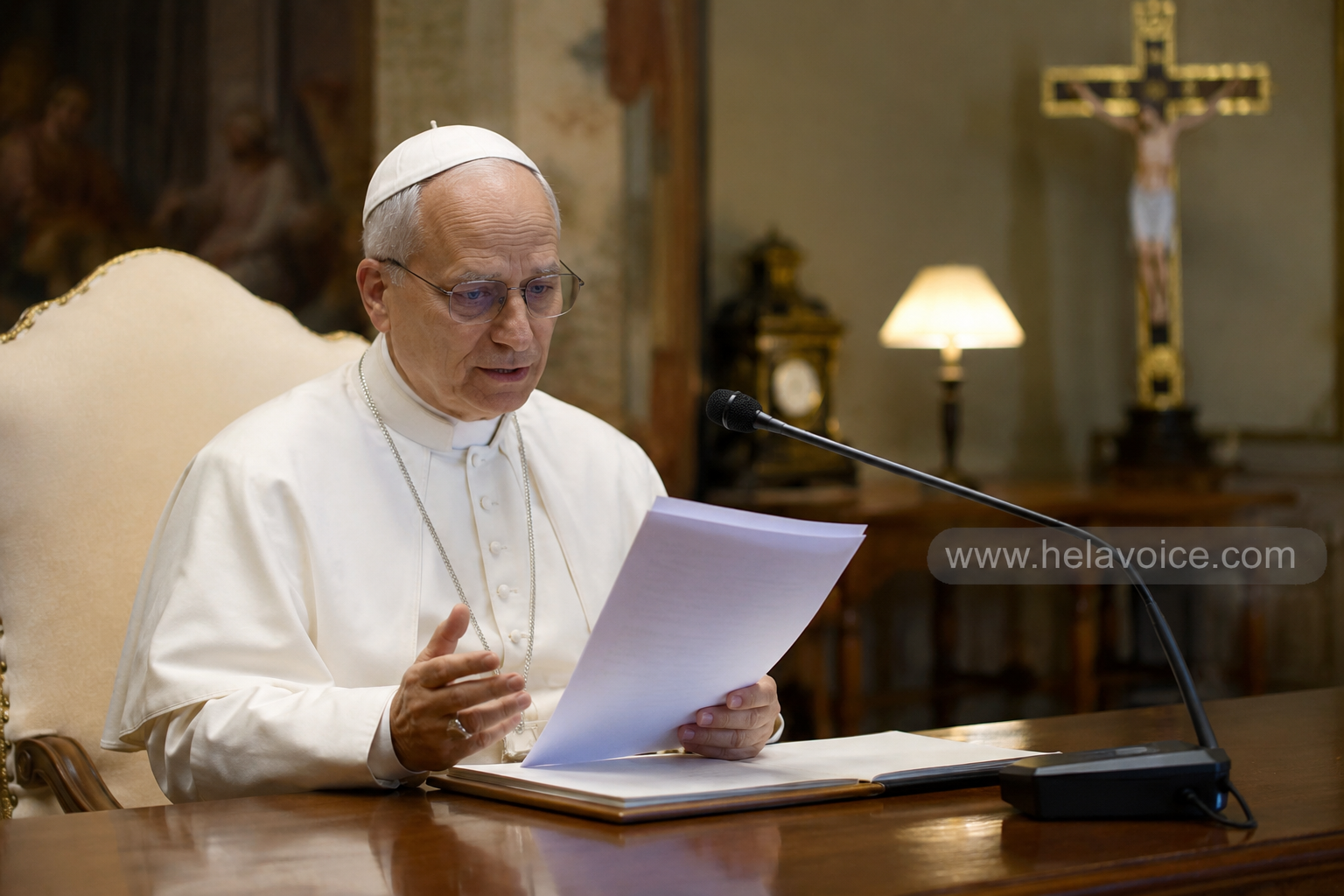
Pope Leo XIV has issued a powerful global warning over the rapid development of artificial intelligence, urging governments and technology companies to “slow down” AI expansion and introduce stronger regulation before the technology begins causing irreversible harm to society.
The remarks were made in the Pope’s first major manifesto, officially released on Monday, where he raised serious concerns about misinformation, global conflict, unethical technological competition, and the growing dangers of allowing AI systems to evolve without proper human oversight.
The document, titled Magnifica Humanitas (“Magnificent Humanity”), is already being described as one of the Vatican’s most significant statements in recent years regarding artificial intelligence, ethics, and global politics.
Pope Leo warned that AI technologies are increasingly being used to spread false information, fuel political division, manipulate public opinion, and intensify tensions between nations. He stressed that governments must play a far more active role in regulating artificial intelligence instead of allowing major private technology companies to dominate the future direction of AI development.
“What is needed is a more active political involvement that is capable of slowing things down when everything is accelerating,” the Pope stated in the manifesto.
The Vatican leader also called for stronger legal protections, independent oversight mechanisms, and safeguards for workers and children who could be negatively affected by AI systems and automation in the future.
According to the Vatican, the nearly 43,000-word document had been in development for close to a year and became one of Pope Leo’s highest-priority global messages following his election as pope.
Beyond artificial intelligence, the manifesto addresses broader modern global issues including war, economic inequality, political instability, labor exploitation, and social justice. One of the strongest sections focused on the increasing role of advanced technology in modern warfare.
Pope Leo strongly criticized the growing normalization of violence in global politics and warned humanity against moving toward a future where peace becomes merely a temporary pause between conflicts.
He also questioned the continued relevance of the centuries-old “just war” theory, arguing that it has too often been used throughout history to justify violence and military aggression.
“The ‘just war’ theory which has all too often been used to justify any kind of war, is now outdated,” the Pope wrote.
The Pope further warned against allowing artificial intelligence systems to make lethal military decisions independently. He insisted that any use of AI in warfare must face the strictest ethical limitations and declared that machines should never be allowed to decide matters involving human life and death without human accountability.
At a Vatican event following the release of the manifesto, technology leaders also acknowledged growing concerns surrounding advanced AI systems. Chris Olah, co-founder of AI company Anthropic, publicly praised Pope Leo for highlighting the ethical and societal risks connected to artificial intelligence.
Olah admitted that even major AI companies face intense commercial pressure that can sometimes conflict with making ethically responsible decisions.
The Pope also highlighted labor exploitation within global technology supply chains, describing some working conditions linked to AI production as “new forms of slavery.” He specifically referred to factory workers and children involved in dangerous mining operations used to extract rare earth materials required for smartphones, computers, and AI infrastructure.
According to Pope Leo, the suffering experienced by such workers raises serious moral concerns that cannot be ignored while technology companies continue rapidly expanding their global influence.
In another major moment from the manifesto, Pope Leo formally apologized for the Catholic Church’s historical failure to strongly condemn transatlantic slavery during earlier centuries.
“This constitutes a wound in Christian memory,” he wrote while asking forgiveness on behalf of the Church.
For Sri Lanka, the growing global debate over artificial intelligence is becoming increasingly relevant as AI-powered systems rapidly spread across education, business, media, banking, cybersecurity, and social media platforms used by millions of Sri Lankans. Discussions surrounding misinformation, automation, digital ethics, and the future of employment are also becoming more prominent locally.
Technology analysts say Pope Leo’s intervention could significantly intensify global debate surrounding AI regulation and increase pressure on governments to introduce stronger laws controlling artificial intelligence development before the technology becomes too powerful to regulate effectively.
The manifesto concluded with a broader warning that technological progress without ethical responsibility could ultimately lead humanity toward division, instability, and destruction rather than genuine advancement. Using the biblical story of the Tower of Babel as a symbolic example, the Pope cautioned against unchecked human ambition driven solely by power and profit.
He emphasized that while not every individual holds equal influence over the future of artificial intelligence, all people still carry responsibility for the societal choices being made today.
What happens next will likely depend on how governments, technology companies, and international organizations respond to mounting global pressure for stronger AI regulation and ethical oversight in the years ahead.