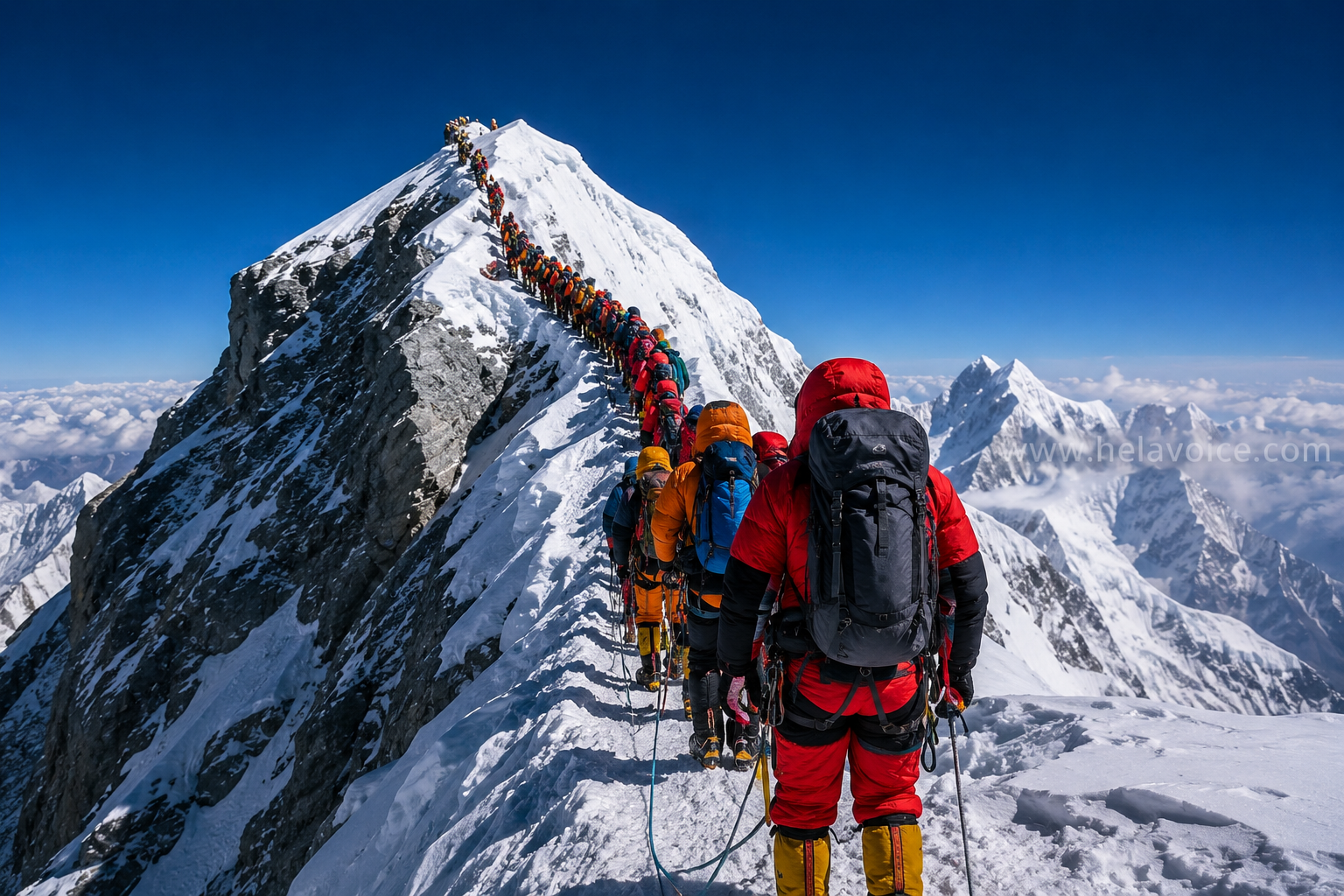
Mount Everest witnessed a historic moment this week as a record-breaking 274 climbers successfully reached the summit in a single day from the Nepali side of the mountain, according to Nepalese hiking officials.
The achievement marks the highest number of climbers ever recorded reaching the world’s tallest mountain on the same day through the Nepal route, surpassing the previous record set in 2019.
Standing at 8,849 metres (29,032 feet), Mount Everest lies along the border between Nepal and China’s Tibet region and is traditionally climbed from both sides. However, expedition operators confirmed that no climbers ascended from the Tibetan side this year because Chinese authorities had not issued climbing permits for the season.
Rishi Bhandari, Secretary General of the Expedition Operators Association of Nepal, stated that the previous highest number of successful ascents from the Nepali side was 223 climbers on May 22, 2019. He added that Wednesday’s figure of 274 climbers has now officially broken that record.
According to Guinness World Records, the overall global record for the highest number of climbers reaching Everest from both the Nepali and Tibetan sides was recorded on May 23, 2019, when 354 people reached the summit in a single day.
Bhandari noted that the number of successful climbers this year could rise further, as some climbers may not yet have officially reported their summit achievements to the Everest base camp authorities.
Meanwhile, Nepal’s Department of Tourism also confirmed preliminary reports indicating that more than 250 climbers had successfully reached the peak during Wednesday’s climbing window. Officials stated that final confirmation would only be issued after climbers return safely and provide photographic evidence and documentation required for official certification.
Nepal has issued 494 climbing permits for Mount Everest this season, with each permit costing approximately 15,000 US dollars. The country earns millions of dollars annually through mountaineering tourism, which remains one of Nepal’s most important sources of foreign income.
Despite the celebrations surrounding the record-breaking achievement, concerns continue to grow over overcrowding on Mount Everest. Mountaineering experts have repeatedly criticised the large number of permits issued each season, warning that heavy congestion near the summit can create life-threatening conditions for climbers.
Long queues are especially dangerous inside the mountain’s infamous “death zone” — an area near the summit where oxygen levels are critically low and human survival becomes increasingly difficult. Delays caused by overcrowding have previously contributed to several deaths on Everest.
In response to these concerns, Nepal has introduced stricter regulations and higher permit fees in recent years to improve safety standards and reduce risks posed by inexperienced climbers.
However, some expedition organisers believe the high number of climbers can still be managed safely with proper planning and adequate oxygen supplies.
Lukas Furtenbach, founder of Austria-based Furtenbach Adventures, said large crowds are not necessarily a problem if expeditions are professionally organised and properly equipped. He explained that his teams avoided major congestion by climbing behind the main groups.
He further compared Everest traffic to popular Alpine mountains in Europe, saying some peaks in the Alps receive thousands of climbers per day, making Everest’s 274 climbers relatively manageable considering the mountain’s massive size.
The latest Everest record once again highlights both the growing popularity of high-altitude adventure tourism and the ongoing debate surrounding safety, environmental impact, and overcrowding on the world’s tallest mountain.